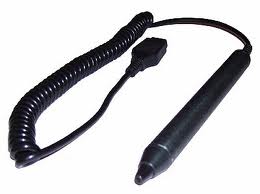
Light pen
A small, photosensitive device connected to a computer and moved by hand over an output display in order to manipulate information in the computer.
Light pens have the advantage of 'drawing' directly onto the screen, but this can become uncomfortable, and they are not as accurate as digitising tablets.
An input device that utilizes a light-sensitive detector to select objects on a display screen. A light pen is similar to a mouse, except that with a light pen you can move the pointer and select objects on the display screen by directly pointing to the objects with the pen.
A light-sensitive stylus wired to a video terminal used to draw pictures or select menu options. The user brings the pen to the desired point on screen and presses the pen button to make contact. Contrary to what it looks like, the pen does not shine light onto the screen; rather, the screen beams into the pen. Screen pixels are constantly being refreshed. When the user presses the button, the pen senses light, and the pixel being illuminated at that instant identifies the screen location.
An early pointing device which the user pointed at a raster -scanned display screen. A photocell in the pen detected the flying spot of the raster scan. The position of the spot at that instant, obtained from the scanning electronics, was made available to software as (x, y) co-ordinates.


